> ## Documentation Index
> Fetch the complete documentation index at: https://docs.upsonic.ai/llms.txt
> Use this file to discover all available pages before exploring further.
# What is Upsonic
> Python framework for building autonomous and traditional AI agents, with tools, memory, RAG, multi-agent teams, and production deployment.
 # Upsonic Framework
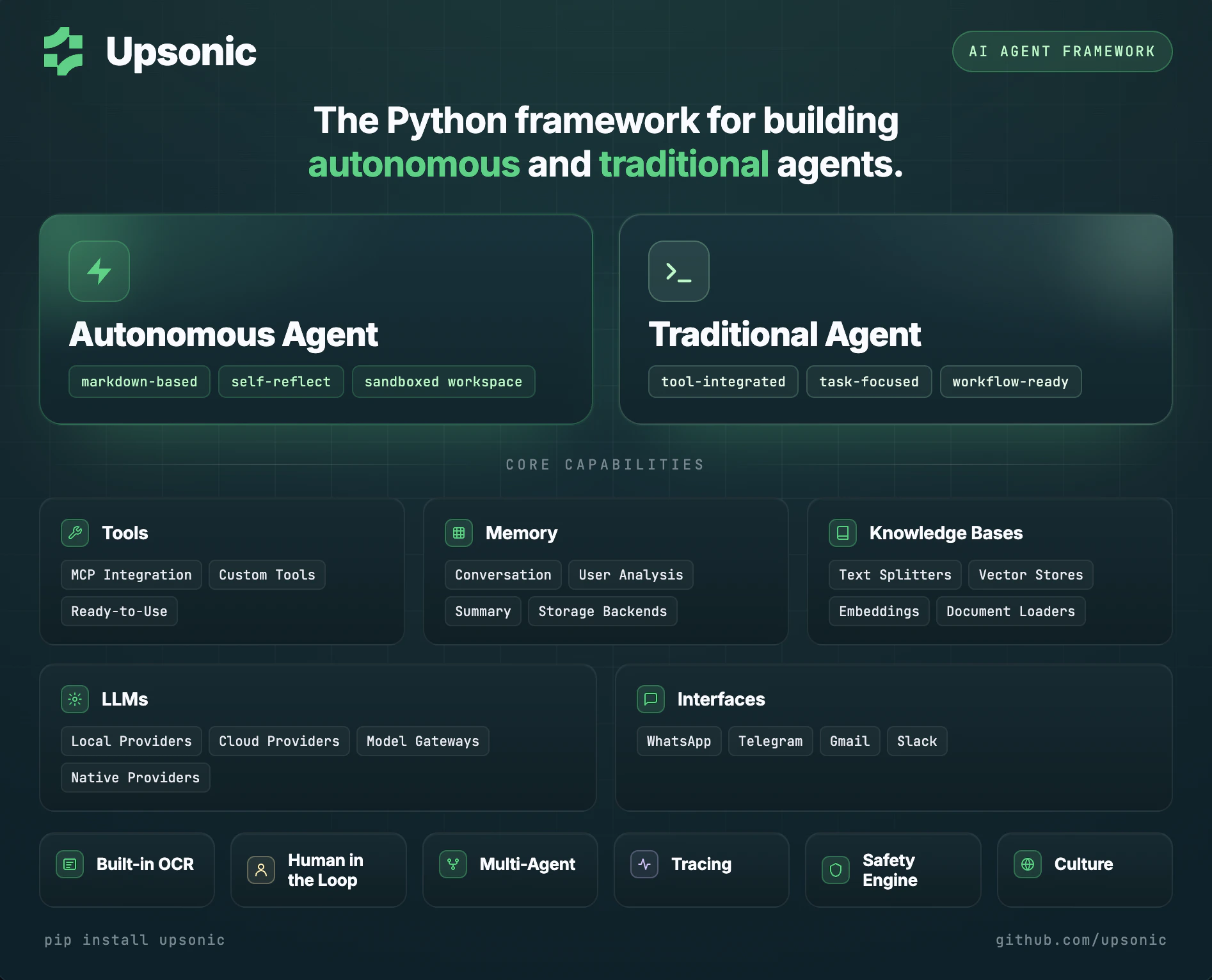
Upsonic is a Python framework for building **autonomous agents** like OpenClaw and Claude Cowork, as well as traditional single-task agents and multi-agent teams. One unified API and pipeline covers every primitive you need, including agents, tools, memory, knowledge bases, teams, and deployment.
### Install
```bash theme={null}
uv pip install upsonic
# pip install upsonic
```
### Configure API Keys
Put your provider keys in a `.env` file. Upsonic supports 30+ providers, including OpenAI, Anthropic, Google, Bedrock, Azure, Ollama, vLLM, Groq, and OpenRouter.
```shellscript OpenAI theme={null}
OPENAI_API_KEY=sk-***
```
```shellscript Anthropic theme={null}
ANTHROPIC_API_KEY=sk-***
```
```shellscript Ollama theme={null}
OLLAMA_BASE_URL="http://localhost:11434/v1/"
```
See the full list in [LLM Support](/concepts/llm-support/llm-overview).
# Upsonic Framework
Upsonic is a Python framework for building **autonomous agents** like OpenClaw and Claude Cowork, as well as traditional single-task agents and multi-agent teams. One unified API and pipeline covers every primitive you need, including agents, tools, memory, knowledge bases, teams, and deployment.
### Install
```bash theme={null}
uv pip install upsonic
# pip install upsonic
```
### Configure API Keys
Put your provider keys in a `.env` file. Upsonic supports 30+ providers, including OpenAI, Anthropic, Google, Bedrock, Azure, Ollama, vLLM, Groq, and OpenRouter.
```shellscript OpenAI theme={null}
OPENAI_API_KEY=sk-***
```
```shellscript Anthropic theme={null}
ANTHROPIC_API_KEY=sk-***
```
```shellscript Ollama theme={null}
OLLAMA_BASE_URL="http://localhost:11434/v1/"
```
See the full list in [LLM Support](/concepts/llm-support/llm-overview).
# Two ways to build
Upsonic gives you two agent primitives depending on the problem shape.
For open-ended, multi-step work. The agent plans, executes shell and filesystem operations, and iterates inside a sandboxed `workspace` that blocks path traversal and dangerous commands.
For structured, tool-driven tasks with a defined input/output contract. Bring your own tools, response schemas, and run the agent over a `Task`.
### Autonomous Agent
```python theme={null}
from upsonic import AutonomousAgent, Task
agent = AutonomousAgent(
model="anthropic/claude-sonnet-4-5",
workspace="/path/to/logs"
)
task = Task("Analyze server logs and detect anomaly patterns")
agent.print_do(task)
```
All file and shell operations are restricted to `workspace`. For isolated cloud execution, plug in an [E2B sandbox](/concepts/autonomous-agent/overview).
### Traditional Agent
```python theme={null}
from upsonic import Agent, Task
from upsonic.tools import tool
@tool
def sum_tool(a: float, b: float) -> float:
"""Add two numbers together."""
return a + b
agent = Agent(model="anthropic/claude-sonnet-4-5", name="Calculator")
task = Task(description="Calculate 15 + 27", tools=[sum_tool])
agent.print_do(task)
```
# Core building blocks
Ready-to-run autonomous agents contributed by the community. Install and go.
Function tools with `@tool`, full MCP support, and ready-to-use integrations (Tavily, Firecrawl, E2B, YFinance, and more).
Conversation, focus, and summary memory with pluggable backends: SQLite, Postgres, Redis, Mongo, and Mem0.
End-to-end RAG: document loaders, text splitters, 7+ embedding providers, and vector stores (Qdrant, Pinecone, Chroma, pgvector, Weaviate).
Coordinate multiple agents with Sequential, Coordinate, or Route modes.
Package reusable agent capabilities and load them from local paths, URLs, or GitHub.
Unified OCR interface across EasyOCR, Tesseract, PaddleOCR, DeepSeek, and more.
Human-in-the-loop for confirmations, user input, and durable execution pauses.
First-class tracing with Langfuse and PromptLayer.
Optional guardrails with prebuilt privacy, financial, security, and content policies.
# Next steps
Run your first agent in under five minutes.
Seven short guides covering tasks, agents, tools, MCP, memory, and teams.
Real-world examples: DevOps bots, document analyzers, research agents, sales workflows.
Add `https://docs.upsonic.ai/llms-full.txt` to Cursor, VSCode, or Windsurf.
# Community
* **[Discord](https://discord.gg/pmYDMSQHqY)**: Chat with the team and other developers.
* **[GitHub](https://github.com/Upsonic/Upsonic)**: Source, issues, and discussions.
* **[Changelog](/changelog)**: What shipped in each release.